
Early concept. Not a product. Illustrations only.
Visual information. Tactile control.
Imagine capturing a restaurant menu through your glasses, reading it in braille on your wrist, and pressing a raised dot to move to the next item.
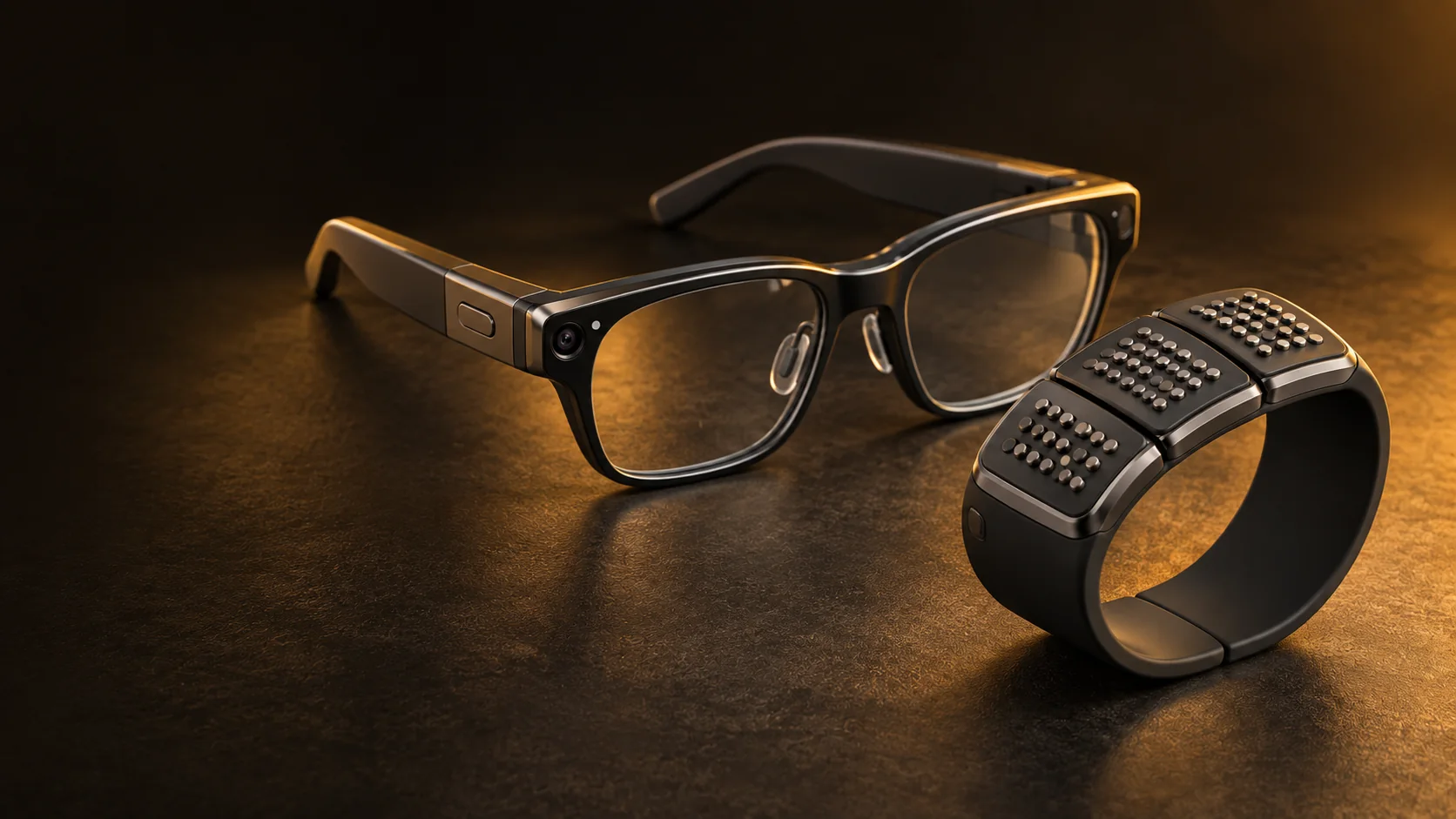
Palm Hill is exploring a wearable system for people who are blind or have low vision and use braille. Camera glasses would capture visual information, a connected phone would interpret it, and a pressable braille wristband would put short messages and controls at your fingertips.
A closer look through touch
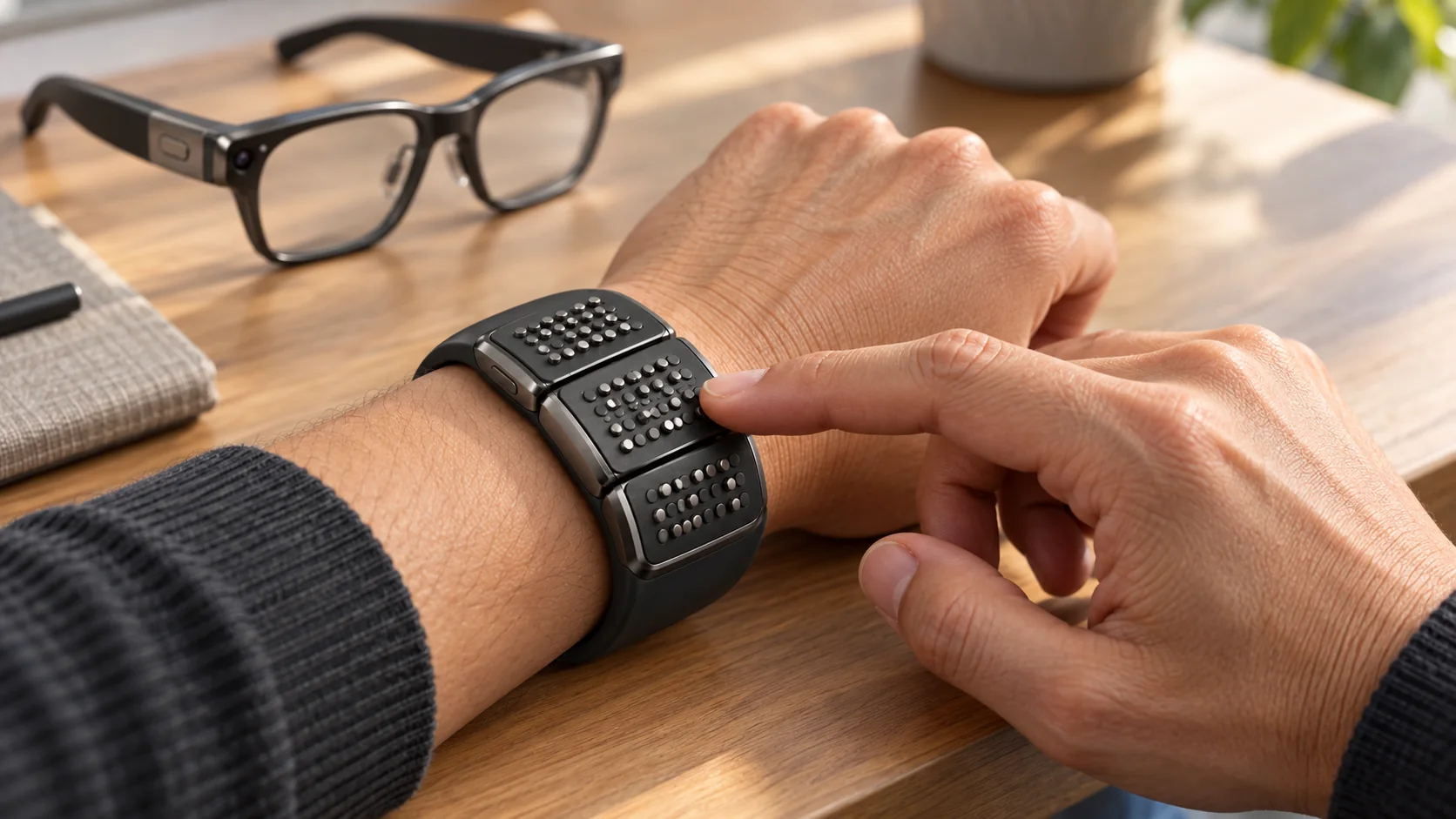
The proposed interface would let the wearer choose what to capture and what to explore next.
Read everyday text
The wearer could capture a menu, package label, or sign and read the recognized text in short braille passages, with controls to advance, go back, or repeat.
Follow your curiosity
The wearer could request a brief scene description, then select an object or detail to learn more. A deliberate press could ask the next question.
Stay in control
Light contact would let you read the dots. A firmer press would select an action. A brief vibration could signal when information is ready.
A cuff with room to move
We envision a compact cuff with rigid tactile modules joined by a flexible band. Electromagnetic actuators would raise and lower the dots, while separate sensors would detect deliberate presses. Flexibility between modules would let the band follow the wrist while keeping the mechanisms aligned.
The phone would handle much of the processing. Comfort, readable dot spacing, and dependable press detection would need to be explored with braille readers and prospective users.
An idea with a longer history
Palm Hill co-founder Edgett Hilimire first developed this concept around 2016. Today, we are revisiting the idea with tools that could make a specialized wearable more practical to develop.
A bridge toward future interfaces
Brain–computer interfaces may eventually offer new ways to access visual information through the nervous system. Their path to broad availability, affordability, and everyday usefulness remains uncertain.
We see this concept as a possible bridge between today’s accessibility tools and that future: a noninvasive way to connect visual information with touch through glasses, a phone, and a wristband. It could also remain a useful choice as neural technologies mature. More ways to interact means more room for individual preference.
Small batches with a bigger toolkit
AI has two roles in this idea. It would help interpret text and scenes for the wearer, and it could help a small team develop the device itself.
AI-assisted development could help with software, design exploration, manufacturing documentation, and analysis of future prototype tests. Reducing some of that upfront effort matters when development costs must be spread across a smaller number of devices.
Combined with reusable tactile modules, off-the-shelf electronics where suitable, 3D-printed housings and assembly fixtures, and small-batch manufacturing, these tools could make a focused production run more practical. The opportunity is to build around a community’s needs at a scale that fits.
That opportunity still needs to be tested. Supplier quotes, working prototypes, and trials with prospective users would establish the real costs and capabilities. AI can help a small team do more; dependable hardware still takes careful engineering.
A nod to Orbit Research
We want to recognize Orbit Research’s Graphiti Plus® – Interactive Tactile Graphics and Braille Computer, which brings refreshable tactile graphics, braille, and touch interaction together in one device. We appreciate the teams expanding access to digital information as we explore our own wearable direction.
Help shape the next step
We’d welcome conversations with braille readers, accessibility researchers, hardware engineers, and people interested in helping this idea take shape.
Early concept. Not a product. Illustrations only. Hardware, usability, and production feasibility remain to be validated.
Discuss the concept